Mars facts · Surface
The surface of Mars
The surface of Mars is a cold, dusty desert of reddish rock and sand, with the solar system’s tallest volcano and a canyon system 3,870 km (2,400 mi) long. Its north is mostly low, smooth plains; its south is cratered highland about 5 km (3 mi) higher on average. Both poles have ice caps.
Updated Sources (26)
What does Mars look like?
From the ground, Mars looks like a cold, dusty desert in shades of brown, gold and tan. It looks reddish because iron minerals in its rocks, regolith and dust have oxidized, or rusted, NASA says, and dust blown into the air makes the whole planet look red from a distance.[1] Why Mars is red has its own page.
To human eyes the daytime sky would look hazy and red, because of dust hanging in the air.[1] Sunsets go the other way. When Curiosity photographed the Sun setting over Gale Crater on Apr 15, 2015, the glow around the Sun was blue: fine dust lets blue light through more easily than red and keeps it close to the Sun. The effect is strongest near sunset.[2] Now and then, winds raise dust storms that cover much of the planet, and the dust can take months to settle.[1]
To see what the RoverA rover is a robot vehicle that drives across Mars, following plans its team on Earth sends ahead of each drive.More in the glossary see now, look at the newest raw pictures from the rovers.
The newest pictures from the surface of Mars
The latest raw images from NASA’s Perseverance and Curiosity rovers, straight from the ground they are exploring. Each one opens full size on our Mars photos page.
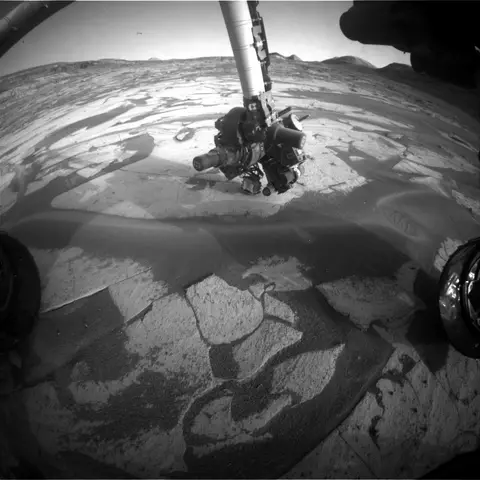 Curiosity · Sol 5,038Front Hazard Avoidance Camera (Hazcam)NASA/JPL-Caltech
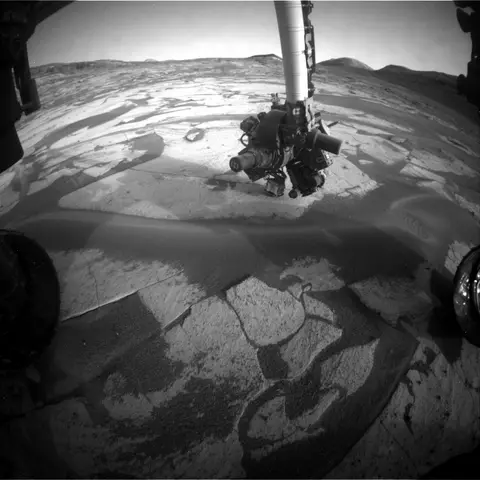 Curiosity · Sol 5,038Front Hazard Avoidance Camera (Hazcam)NASA/JPL-Caltech
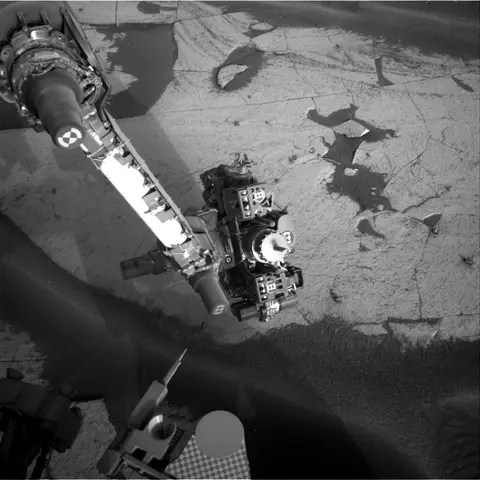 Curiosity · Sol 5,038Navigation Camera (Navcam)NASA/JPL-Caltech
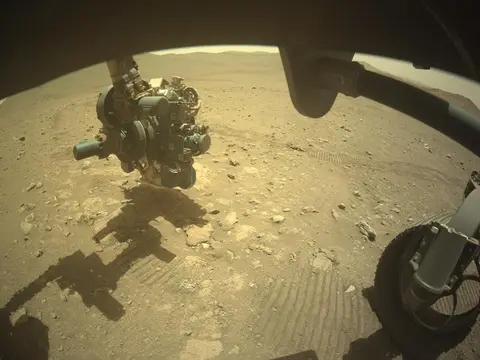 Perseverance · Sol 2,000Front Hazard Avoidance Camera (Hazcam)NASA/JPL-Caltech
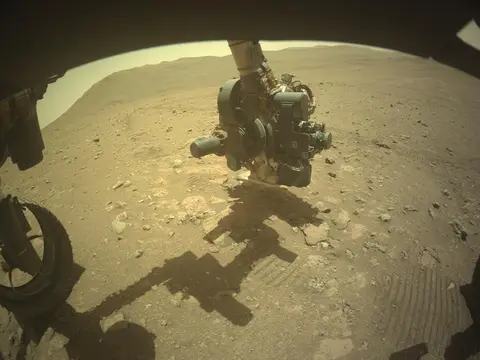 Perseverance · Sol 2,000Front Hazard Avoidance Camera (Hazcam)NASA/JPL-Caltech
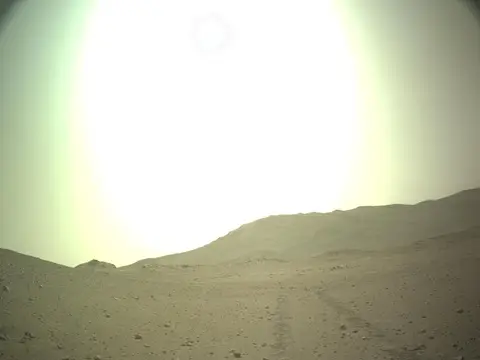 Perseverance · Sol 2,000Navigation Camera (Navcam)NASA/JPL-Caltech
What is the terrain like on Mars?
Mars is split in two: the north is mostly low, smooth plains, and the south is heavily cratered highland that sits about 5 km (3 mi) higher on average. David Smith, who led the laser altimeter that mapped the heights of Mars from NASA’s Mars Global Surveyor, called that split “the most curious aspect” of the map.[3]
The full range of heights on Mars is about 30 km (19 mi), one and a half times Earth’s.[3] Early in Mars’s history, the slope from the south pole down to the north steered its water: models show the northern lowlands would have drained three-quarters of the surface.[3] Mars is about half as wide as Earth, but its surface has nearly the same area as Earth’s dry land. Volcanoes, impacts, movements of the crust and dust storms have all reshaped it.[1]
The biggest landmarks are in the table below. Valles Marineris, the largest canyon in the solar system, would stretch from California to New York, and is more than 10 times longer and wider than the Grand Canyon, NASA says.[1] Olympus Mons, the tallest volcano, has its own page.
Where the landmarks are
| Landmark | What it is | Size | Where |
|---|---|---|---|
| Olympus Mons | Shield volcano, the tallest known in the solar system | 21.9 km (13.6 mi) high600 km (370 mi) wide | 18.7° N, 226.2° E |
| Tharsis | Volcanic plateau with Olympus Mons and three more giant volcanoes, the Tharsis Montes | About 4,000 km (2,500 mi) wideabout 10 km (6 mi) above its surroundings | Near the equator; the Tharsis Montes are at 1.6° N, 247.4° E |
| Valles Marineris | Canyon system, the largest in the solar system | 3,870 km (2,400 mi) longup to 600 km (370 mi) wide and 9.3 km (5.8 mi) deep | 14.0° S, 301.4° E |
| Hellas | Giant impact basin | About 2,100 km (1,300 mi) acrossnearly 9 km (6 mi) deep | 42.4° S, 70.5° E |
| North polar cap | Water ice, under a thin coat of dry ice that grows each winter | About 1,000 km (620 mi) acrossice layers about 2 km (1.2 mi) deep | North pole |
| South polar ice | Layered deposits, at least 90% water ice | Up to 3.7 km (2.3 mi) thickover an area bigger than Texas | South pole |
| Gale Crater | Ancient lakebed explored by Curiosity, with Mount Sharp in the middle | 154 km (96 mi) wideMount Sharp is 5 km (3 mi) tall | 5.4° S, 137.8° E |
| Jezero Crater | Ancient lake and river delta explored by Perseverance | 45 km (28 mi) wide | 18.4° N, 77.7° E |
| Meridiani Planum | Plain rich in hematite, explored by Opportunity | Hematite over an area the size of Oklahomaas seen from orbit | 0.0°, 356.9° E |
Sizes from NASA and ESA. Coordinates are feature centers from the USGS/IAU Gazetteer of Planetary Nomenclature, in degrees of latitude and east longitude.[1][3][4][5][6][7][8][9][10][11][12][13][14]
How many craters does Mars have?
A 2012 catalog lists 384,343 craters on Mars that are at least 1 km (0.6 mi) wide.[15] Stuart Robbins and Brian Hynek of the University of Colorado Boulder built it; Robbins spent four years drawing crater rims on maps.[16] Smaller craters make up the bulk of Mars’s craters.[16] Some are vast: the Hellas impact basin is about 2,100 km (1,300 mi) across.[3]
Craters work as a clock: the more craters a surface has, the longer it has been around, Robbins said. Volcanic activity and erosion have wiped older craters off much of the planet.[16] Mars’s thin air gives little protection from meteorites, asteroids and comets, NASA says.[1] Earth, by contrast, has only about 150 to 200 known impact craters left; it has lost most of its geologic record to moving plates and erosion.[16]
What is Mars soil like?
Martian soil, which scientists call regolith, is mostly dust and sand made from volcanic rock, with salts mixed in.[1][17][18] Curiosity’s first soil sample, in 2012, was similar to weathered volcanic soils in Hawaii. It held the minerals feldspar, pyroxene and olivine, and roughly half of it was non-crystalline material such as volcanic glass. The sample mixed dust spread around the planet by storms with sand from nearby.[17]
NASA’s Phoenix lander, which worked on an arctic plain in 2008, found a salt called perchlorate in all three soil samples it tested, at a few tenths of a percent. Perchlorate strongly attracts water and could pull humidity from the air. Astronauts might one day use it for rocket fuel or to make oxygen, NASA said. Phoenix also found water ice, as its team expected, and calcium carbonate, which points to thin films of liquid water in the soil in the past.[18] Water on Mars covers that ice.
What are Mars rocks made of?
Much of what orbiters and rovers have found is volcanic rock such as basalt, but rovers have also found rocks that formed in water. A 2000 study of data from NASA’s Mars Global Surveyor matched the dark region Terra Cimmeria to sand-sized basalt from Earth, and found signs of basalt in other dark regions and at the Viking and Pathfinder landing sites.[19] Perseverance found that the floor of Jezero Crater is made of two kinds of volcanic rock that had interacted with water.[12]
Water-laid rocks tell of Mars’s wetter past. In 2013 Curiosity drilled a fine-grained mudstone in Gale Crater that held clay and sulfate minerals. It showed the spot had been the end of an ancient river system or an on-and-off wet lakebed that could have suited microbes.[20] At Jezero, river channels spilled over the crater wall more than 3.5 billion years ago and made a lake with a delta, which Perseverance has explored.[12]
What minerals are on Mars?
Rovers and orbiters have found iron oxides such as hematite, clays, sulfates and other salts, and even pure sulfur.
- Hematite. In 2004 Opportunity found that hematite is a major ingredient of the BB-sized balls scattered around its landing site, nicknamed “blueberries” though more gray than blue. On Earth this iron mineral usually forms in water. Orbiters had seen hematite across an area of Meridiani Planum the size of Oklahoma.[13]
- Clays. They form when fairly fresh water reacts with volcanic minerals such as olivine. Clay made up at least 20% of the rock Curiosity drilled in 2013.[20]
- Sulfates. These sulfur salts were left behind as water dried up, and on dry Mars they can last billions of years. Part of Mount Sharp where Curiosity has worked is rich in them.[21][22]
- Pure sulfur. In 2024 Curiosity found yellow crystals of elemental sulfur inside a crushed rock, the first time this mineral has been found in pure form on Mars. Its team doesn’t yet know how it formed.[21]
- A likely new mineral. In 2025 a team led by Janice Bishop of the SETI Institute and NASA Ames reported ferric hydroxysulfate at two sites near Valles Marineris. Lab tests suggest it forms only when iron sulfates are heated in the presence of oxygen; in the tests it formed at 100 °C (212 °F) or above. It is likely a new mineral, Bishop said, but it must also be found on Earth to be officially recognized.[22][26]
Are there sand dunes on Mars?
Yes, and some of them move. The Bagnold Dunes are a dark band of sand along the northwest side of Mount Sharp in Gale Crater. Some are up to two stories tall; one that Curiosity studied is as broad as a football field. Images from orbit show some of them moving as much as about 1 m (3 ft) per Earth year.[23][24] Curiosity reached them in late 2015: the first close-up study of active sand dunes anywhere but Earth.[23]
NASA’s Mars Reconnaissance Orbiter has watched dunes move from above. Its HiRISE camera caught a dune in Nili Patera, the caldera of an ancient volcano, advancing between Oct 13, 2007, and May 11, 2010. A 2012 study in Nature found that Martian dunes move about as much sand over time as dunes in Antarctica.[25]
Questions
What is the surface of Mars made of?
Volcanic rock such as basalt, and dust and sand made from it. Places that once had water also hold clays, sulfates and other salts.
What color is the surface of Mars?
Mostly reddish, with browns, golds and tans. Iron minerals in the rocks, soil and dust have oxidized, or rusted, NASA says.
How cold is the surface of Mars?
From about 20 °C (68 °F) at the warmest to about −153 °C (−243 °F) at the coldest, NASA says.
Is there water on the surface of Mars?
Mostly as ice. NASA says the air is too thin for liquid water to last long on the surface. The polar caps hold water ice, and more lies just under the ground.
How many craters are on Mars?
At least 384,343 that are 1 km (0.6 mi) wide or more, in a 2012 catalog. Smaller craters make up the bulk of Mars’s craters.
What is the highest point on Mars?
The peak of Olympus Mons, 21.9 km (13.6 mi) high, ESA says. It is the tallest volcano known in the solar system.
Sources
- NASA Science — Mars: FactsPrimary · checked Oct 6, 2026
- NASA Science (Photojournal) — Sunset in Mars’ Gale Crater (PIA19400)Primary · checked Oct 6, 2026
- NASA Goddard Space Flight Center — Mars Topography (MOLA)Primary · checked Oct 6, 2026
- ESA — Landslides at the foot of Olympus MonsPrimary · checked Oct 6, 2026
- NASA — NASA’s Mars Odyssey Captures Huge Volcano, Nears 100,000 OrbitsPrimary · checked Oct 6, 2026
- ESA — Geography of MarsPrimary · checked Oct 6, 2026
- ESA — Mars Express science highlights #5: Recent and episodic volcanismPrimary · checked Oct 6, 2026
- ESA — Crowning gloryPrimary · checked Oct 6, 2026
- NASA JPL — Mars’ South Pole Ice Deep and WidePrimary · checked Oct 6, 2026
- NASA JPL — Simulated View of Gale Crater Lake on Mars (PIA19080)Primary · checked Oct 6, 2026
- NASA Science — Curiosity Reaches 1-Kilometer Elevation GainPrimary · checked Oct 6, 2026
- NASA Science — Mars 2020: Perseverance RoverPrimary · checked Oct 6, 2026
- NASA JPL — Mineral in Mars ‘Berries’ Adds to Water StoryPrimary · checked Oct 6, 2026
- USGS / IAU — Gazetteer of Planetary Nomenclature: MarsPrimary · checked Oct 6, 2026
- AGU — A new global database of Mars impact craters ≥1 km: 1. Database creation, properties, and parameters (Robbins and Hynek, Journal of Geophysical Research: Planets, 2012)Primary · checked Oct 6, 2026
- AGU — Impact atlas catalogs over 635,000 Martian cratersPrimary · checked Oct 6, 2026
- NASA JPL — NASA Rover’s First Soil Studies Help Fingerprint Martian MineralsPrimary · checked Oct 6, 2026
- NASA JPL — NASA Phoenix Results Point to Martian Climate CyclesPrimary · checked Oct 6, 2026
- USGS Publications Warehouse — Identification of a basaltic component on the Martian surface from Thermal Emission Spectrometer data (Christensen et al., 2000)Primary · checked Oct 6, 2026
- NASA JPL — NASA Rover Finds Conditions Once Suited for Ancient Life on MarsPrimary · checked Oct 6, 2026
- NASA Science (Photojournal) — Curiosity Views Sulfur Crystals Within a Crushed RockPrimary · checked Oct 6, 2026
- Planetary Science Institute — Unique mineral sheds light on Mars’ pastPrimary · checked Oct 6, 2026
- NASA JPL — NASA Mars Rover Curiosity Reaches Sand DunesPrimary · checked Oct 6, 2026
- NASA JPL — NASA’s Curiosity Mars Rover Heads Toward Active DunesPrimary · checked Oct 6, 2026
- NASA JPL — Advancing Dune in Nili Patera, Mars (PIA15295)Primary · checked Oct 6, 2026
- Nature Communications — Characterization of ferric hydroxysulfate on Mars and implications of the geochemical environment supporting its formation (Bishop et al., Nature Communications, 2025)Primary · checked Oct 6, 2026