Mars facts · The Red Planet by the numbers
Mars facts
Mars is the fourth planet from the Sun: a cold, dusty desert world about half as wide as Earth, with two small moons and a day about 40 minutes longer than ours. Right now it’s 240 million km (149 million mi) from Earth, and it’s the start of northern spring.
Updated Sources (11)
Mars fact sheet
| Fact | Mars | Earth | Source |
|---|---|---|---|
| Place from the Sun | 4th planetthe next planet out from EarthEarth: 3rd planet | 3rd planet | [2] |
| Average distance from the SunLive | 228 million km (142 million mi)1.52 AU · right now 234.6 million kmEarth: 150 million km (93 million mi) | 150 million km (93 million mi) | [1][3] |
| Distance from EarthLive | Right now 240.2 million km149.2 million mi · from about 55 to 401 million kmEarth: — | — | [1][6] |
| Width (average) | 6,779 km (4,212 mi)about half as wide as EarthEarth: 12,742 km (7,918 mi) | 12,742 km (7,918 mi) | [1][3] |
| Gravity | 3.73 m/s²38% of Earth’sEarth: 9.82 m/s² | 9.82 m/s² | [1] |
| Length of a day | 24 h 39 min 35 sa Mars day is called a SolA sol is a day on Mars — 24 h 39 min 35 s, about 40 minutes longer than ours — and rovers count them from the day they land.More in the glossaryEarth: 24 h | 24 h | [5][2] |
| Length of a year | 687 Earth days669 sols · seasons last about twice as longEarth: 365.25 days | 365.25 days | [1][5] |
| Typical temperature | −65 °C (−85 °F)from about 20 °C (68 °F) at the warmest to −153 °C (−243 °F) at the coldestEarth: 15 °C (59 °F) | 15 °C (59 °F) | [4][2][3] |
| Moons | 2Phobos and Deimos, both tinyEarth: 1 | 1 | [1] |
| Air | 95% carbon dioxidesurface pressure about 0.6% of Earth’sEarth: 78% nitrogen, 21% oxygen | 78% nitrogen, 21% oxygen | [1][3] |
| Tilt of its axis | 25.2°close to Earth’s, so Mars has seasonsEarth: 23.4° | 23.4° | [1][2] |
| Mass | 11% of Earth’sabout a tenthEarth: 100% | 100% | [1] |
| Age | about 4.5 billion yearsformed as the solar system settled into its current layoutEarth: — | — | [2] |
US units are calculated from the metric values. Rows marked Live update every second.
Fun facts about Mars
- Sunsets on Mars are blue.Fine dust in the air lets blue light through more easily than red, so the sky around a setting Sun glows blue.[7]Mars weather →
- Seasons last about twice as long as ours.A Mars year runs 687 Earth days, so each season lasts from about 142 to 194 sols.[2]The Mars calendar →
- It has the biggest volcano in the solar system.Olympus Mons is about 600 km (370 mi) across at its base and rises about 27 km (17 mi).[8][2]Olympus Mons →
- Its dust storms can cover the whole planet.A planet-wide storm in 2018 blocked the sunlight that powered NASA’s Opportunity rover; NASA ended the mission in February 2019.[9]Opportunity’s last days →
- One of its moons is falling.Phobos creeps about 1.8 m (6 ft) closer every century; NASA says it will either crash into Mars or break up into a ring.[10]Phobos, explained →
- You’d weigh 38% of your Earth weight.Mars has about a tenth of Earth’s mass and about half its width, so its surface pulls on you with 38% of Earth’s gravity.[1]Weight calculator →
Mars today, from the surface
The newest raw pictures from NASA’s two working rovers, Perseverance in Jezero Crater and Curiosity in Gale Crater, as they reached Earth.
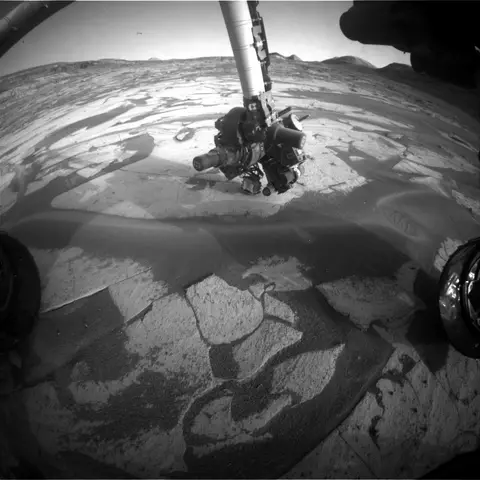 Curiosity · Sol 5,038Front Hazard Avoidance Camera (Hazcam)NASA/JPL-Caltech
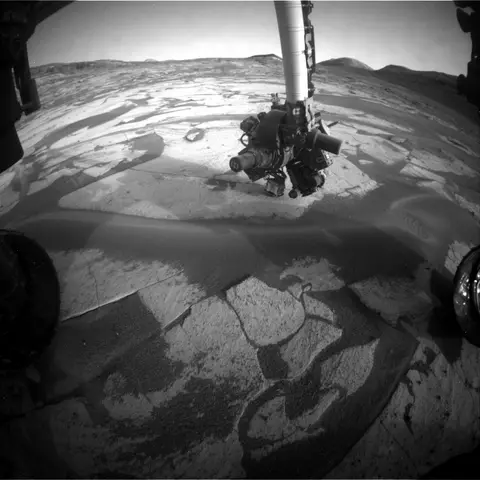 Curiosity · Sol 5,038Front Hazard Avoidance Camera (Hazcam)NASA/JPL-Caltech
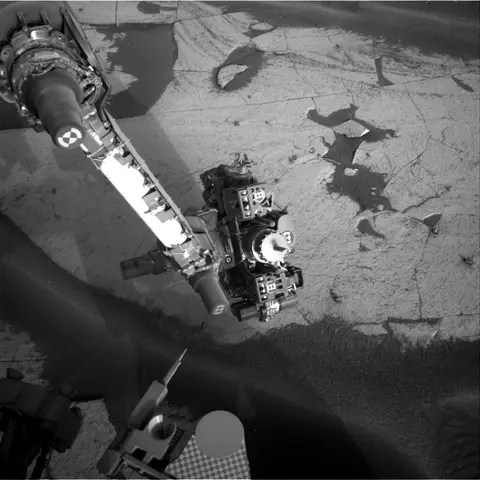 Curiosity · Sol 5,038Navigation Camera (Navcam)NASA/JPL-Caltech
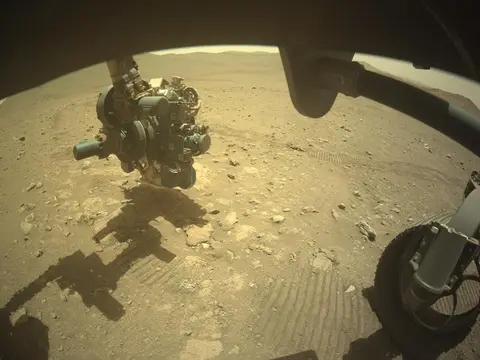 Perseverance · Sol 2,000Front Hazard Avoidance Camera (Hazcam)NASA/JPL-Caltech
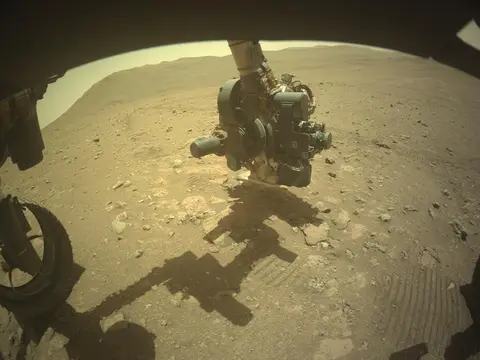 Perseverance · Sol 2,000Front Hazard Avoidance Camera (Hazcam)NASA/JPL-Caltech
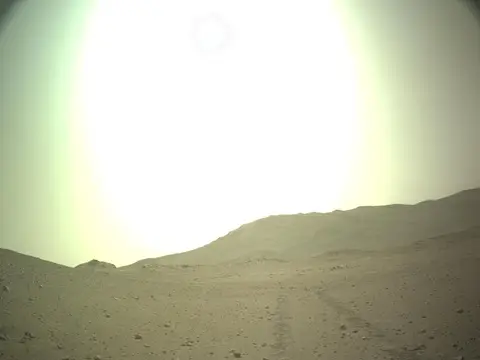 Perseverance · Sol 2,000Navigation Camera (Navcam)NASA/JPL-Caltech
Explore Mars, topic by topic
More Mars topics
- Mars’s atmosphereWhat it’s made of and why it’s so thin
- The surface of MarsWhat it’s like on the ground
- Mars vs EarthSize, gravity, day and year side by side
- How far is Mars from the Sun?Its orbit, from closest to farthest
- Olympus MonsThe biggest volcano in the solar system
- Why is Mars red?Rusty dust
- DeimosMars’s small outer moon
- Mars mapLanding sites, volcanoes and craters
- Valles MarinerisThe solar system’s largest canyon, nearly 4,000 km long
- Hellas PlanitiaMars’s giant impact basin
Questions
How old is Mars?
About 4.5 billion years. NASA says Mars formed when the solar system settled into its current layout, as gravity pulled gas and dust together.
What color is Mars?
Red from a distance, because dust rich in rusted iron covers it. On the surface, rovers see browns, golds and tans.
Why is Mars called the Red Planet?
Because it looks red in our night sky. Iron minerals in its dirt oxidize, or rust, which makes the surface look red.
How far is Mars from Earth?
Right now 240 million km (149 million mi). As both planets circle the Sun, the gap swings between about 55 and 401 million km.
Can you see Mars from Earth?
Yes, with just your eyes: it looks like a bright orange-red star. It’s brightest around OppositionOpposition is when Earth passes between the Sun and Mars, so Mars rises at sunset, stays up all night and looks its brightest — about every 26 months.More in the glossary, next on Feb 19, 2027.
Sources
- NASA NSSDCA — Mars Fact SheetPrimary · checked Oct 2, 2026
- NASA Science — Mars: FactsPrimary · checked Oct 2, 2026
- NASA NSSDCA — Earth Fact SheetPrimary · checked Oct 2, 2026
- NASA Science — Temperatures Across Our Solar SystemPrimary · checked Oct 2, 2026
- NASA GISS — Mars24 Sunclock — Technical Notes on Mars Solar TimePrimary · checked Oct 2, 2026
- NASA JPL Solar System Dynamics — Approximate Positions of the PlanetsPrimary · checked Oct 2, 2026
- NASA JPL — NASA’s Curiosity Rover Views Serene Sundown on MarsPrimary · checked Oct 2, 2026
- NASA — NASA’s Mars Odyssey Captures Huge Volcano as Mission Nears 100,000 OrbitsPrimary · checked Oct 2, 2026
- NASA JPL — NASA’s Opportunity Rover Mission on Mars Comes to EndPrimary · checked Oct 2, 2026
- NASA Science — PhobosPrimary · checked Oct 2, 2026
- NASA JPL Solar System Dynamics — Planetary Satellite Physical ParametersPrimary · checked Oct 2, 2026