Mars news & mission tracker · Perseverance’s day 2,026
Every step toward Mars, tracked live.
The latest on Starship, NASA’s rovers and every mission heading for the Red Planet - with live countdowns, real-time Mars data and a source behind every fact.
Signal delaySignal delay is how long a radio message takes to travel between Earth and Mars at the speed of light: from about 3 to 22 minutes each way, depending on where the planets are.More in the glossary
11 min 52 sone way, at light speed
Next Launch windowA launch window is the stretch of time, about every 26 months, when Earth and Mars line up so a spacecraft can reach Mars using the least fuel.More in the glossary
Oct-Dec 2026then late 2028
Early northern spring on Mars · Ls 15.7°
Mars’s two moons● Phobos circles every 7 h 39 min○ Deimos every 30 h 18 min
Local time at the roversPerseverance 14:15 · Curiosity 18:15
An independent tracker: live numbers worked out in your browser, plain-English explainers, and a dated source behind every fact. Four good places to start:
SpaceX moved Starship’s focus to the Moon before Mars. The Wall Street Journal reported a March 2027 target; in August SpaceX said an uncrewed cargo landing would follow NASA’s Artemis III mission, planned for 2027.
01SpaceX is aiming Starship at the Moon first.SpaceX shifted focus in February 2026; Elon Musk says SpaceX will also try to start a Mars city in about 5 to 7 years. Flight 14 reached orbit on Sep 28, 2026.
02Eight spacecraft are working at Mars.Two RoverA rover is a robot vehicle that drives across Mars, following plans its team on Earth sends ahead of each drive.More in the glossary - Perseverance (day 2,026) and Curiosity (day 5,061) - and six OrbiterAn orbiter circles Mars without landing, studying the planet from above - and many also relay rover data back to Earth.More in the glossary from NASA, Europe, the UAE and China.
03Two missions use this Launch windowA launch window is the stretch of time, about every 26 months, when Earth and Mars line up so a spacecraft can reach Mars using the least fuel.More in the glossary.Japan’s MMX launched on Oct 19 (Oct 20 in Japan) to fetch samples from Mars’s moon Phobos; NASA’s ESCAPADE twins are due to head for Mars in November.
04Mars Sample Return is off.A January 2026 spending bill effectively ended it. The next samples are due from MMX (around 2031) and China’s planned Tianwen-3.
05No crewed landing is scheduled.No agency or company has a funded, dated plan to land people. Official talk points to the 2030s at the earliest.
Countdowns
What happens next
The dates that shape the next six months of Mars exploration, counting down live. Times convert to yours.
Two trackers we keep checked against SpaceX’s and each space agency’s own updates. The summaries are here; the full flight log and mission table are one click away.
Spacecraft don’t fly straight at Mars. They coast halfway around the Sun, so they leave when Mars is about 44° ahead of Earth. Today Mars is 62.0° ahead - scroll to fly the transfer.
This Launch windowA launch window is the stretch of time, about every 26 months, when Earth and Mars line up so a spacecraft can reach Mars using the least fuel.More in the glossary
Oct-Dec 2026Lowest-energy day Oct 31, 2026 (NASA) · MMX and ESCAPADE go
Next window
Late 2028Into early 2029 · Rosalind Franklin, Tianwen-3
Typical trip
7-10 monthsPerseverance took about 7
Mars is ahead of Earth by
62.0°The best launches happen at about 44°. This angle is the Phase angleHere, the phase angle is how far ahead of Earth Mars sits in its orbit, seen from the Sun; trips to Mars work best when it is about 44°.More in the glossary.
Earth · today
Mars · today
Positions live · orbits to scale · path illustrative
From the rovers · updated daily
Latest from the rovers
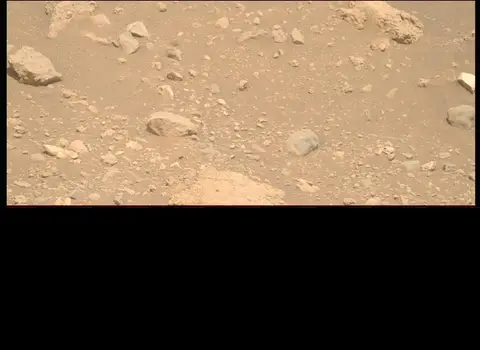
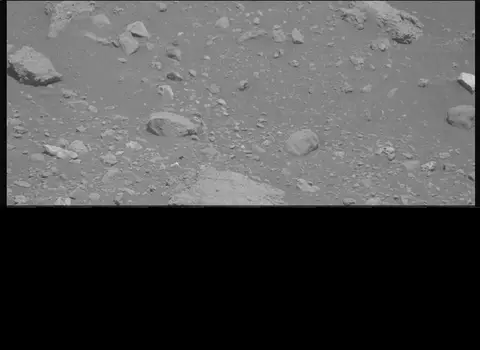
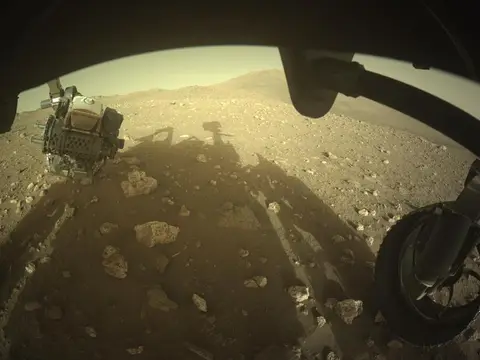
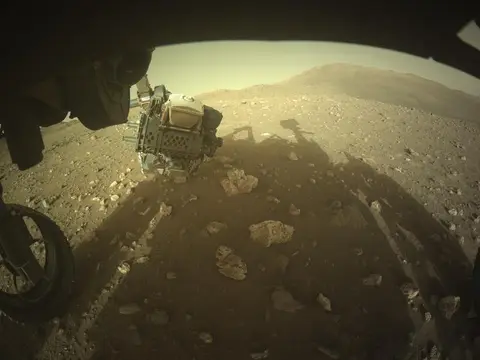
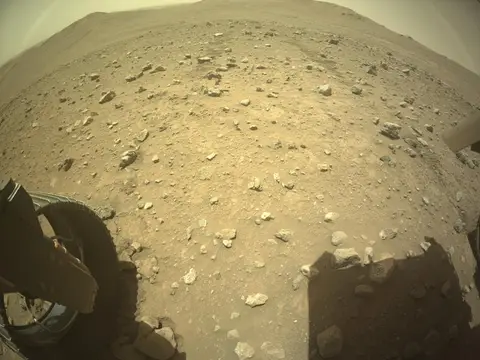
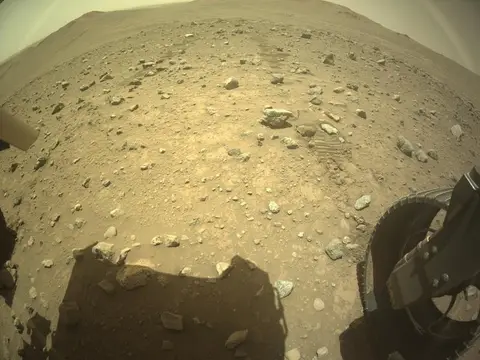
Twelve of the newest raw pictures from NASA’s Perseverance and Curiosity, posted unprocessed soon after they reach Earth.
No. In February 2026 SpaceX shifted Starship’s near-term focus to the Moon, and the Wall Street Journal reported a target of an uncrewed lunar landing in March 2027. In August, SpaceX president Gwynne Shotwell said an uncrewed cargo mission to the Moon would follow Artemis III in 2027, with astronauts landing in 2028. Elon Musk wrote that SpaceX would “also strive to build a Mars city and begin doing so in about 5 to 7 years”. No Starship is scheduled for the late-2026 Launch windowA launch window is the stretch of time, about every 26 months, when Earth and Mars line up so a spacecraft can reach Mars using the least fuel.More in the glossary.
When is the next Mars launch window?
It’s open now. The 2026 window runs roughly October to December, and NASA calculates its lowest-energy day to leave as Oct 31, 2026. The next one opens in late 2028 and runs into early 2029.
When does Japan’s MMX mission launch?
It launched on Oct 20, 2026, at 04:41 Japan time (Oct 19, 19:41 UTC), on an H3 rocket from Tanegashima, and is on its way to Mars. MMX is planned to orbit Mars, land on its moon Phobos, collect samples and bring them back to Earth, with the return planned for Japan’s 2031 fiscal year (April 2031 to March 2032).
How many spacecraft are at Mars right now?
Eight working spacecraft. The Perseverance and Curiosity RoverA rover is a robot vehicle that drives across Mars, following plans its team on Earth sends ahead of each drive.More in the glossary, plus six OrbiterAn orbiter circles Mars without landing, studying the planet from above - and many also relay rover data back to Earth.More in the glossary: NASA’s Mars Reconnaissance Orbiter and Mars Odyssey, Europe’s Mars Express and Trace Gas Orbiter, the UAE’s Hope and China’s Tianwen-1. NASA ended the MAVEN mission in June 2026, saying the spacecraft can’t be recovered.
What happened to Mars Sample Return?
It was effectively cancelled in January 2026 by a congressional spending bill. Perseverance’s sealed samples stay on Mars for now. Japan’s MMX (Phobos samples, due around 2031) and China’s planned Tianwen-3 are the next sample-return missions.
When is Mars brightest in the night sky?
At OppositionOpposition is when Earth passes between the Sun and Mars, so Mars rises at sunset, stays up all night and looks its brightest - about every 26 months.More in the glossary on Feb 19, 2027. Earth passes between Mars and the Sun, so Mars rises at sunset, stays up all night and shines at its brightest of this cycle. It comes closest to Earth the next day, at about 101 million km (63 million mi) - 214 million km (133 million mi) away today.
When will humans land on Mars?
Not before the 2030s. No agency or company has a funded, scheduled crewed landing. Elon Musk says SpaceX will also try to begin a Mars city in about 5 to 7 years; NASA’s plans run through the Moon first.
The Mars Progress Brief
About once a month: what launched, what slipped and what’s next. Five minutes, sourced, no hype.