NASA · RoverActive
Curiosity rover
Curiosity is NASA’s rover in Gale Crater, on day 5,039 of its mission. It landed on Aug 6, 2012, is still working, and is climbing Mount Sharp, the 5 km (3-mile) mountain in the middle of the crater. By NASA’s map data it has driven more than 38 km (23.6 mi).
Updated Sources (21)
Where is Curiosity rover now?
Curiosity is climbing through “Valle Grande”, a valley on the slopes of Mount Sharp, in a layer of rock rich in sulfate minerals. At the end of September 2026 its team wrote that it had driven more than a kilometer since its last drilling site, “Campo Marte”, and had picked a new rock to drill near a spot called “Torres del Paine”.[4] It then drilled its 48th rock target in Gale Crater, “Basque Lakes”, its team wrote on Oct 4, 2026.[20] In a post on Oct 5, the team said the rover’s onboard labs, CheMin and SAM, were analyzing the sample.[21] NASA’s map put it at 4.83°S, 137.39°E on sol 5,021.[5]
On Aug 26, 2026 the rover reached a milestone: it had climbed 1 km (3,281 ft) higher than where it landed, NASA said.[6]
Is Curiosity rover still working?
Yes. NASA’s raw-image page has new pictures from its sol 5,033, taken on Oct 3, 2026.[18] Today is sol 5,039. When it passed 5,000 sols, its team wrote that it “looks forward to the next 5000 sols”. NASA hasn’t set an end date.[8]
Curiosity runs on a nuclear power source that turns heat from decaying plutonium-238 into electricity. Perseverance carries an identical one, which made about 110 watts at the start of its mission.[16] Unlike Perseverance, Curiosity is driven mostly by people: only about 10% of its driving is autonomous, Ars Technica reported after interviewing JPL’s Steven Lee.[17]
How long has Curiosity been on Mars?
Since Aug 6, 2012 (UTC; the evening of Aug 5 in US Pacific time): sol 5,039 today, more than 14 Earth years.[3] It was built to work for at least one Mars year, 687 Earth days, and to drive 5 to 20 km.[2]
It passed its 5,000th sol on Aug 30, 2026, parked at a sand ridge called “Chocolatal” in the foothills of Mount Sharp.[7] By NASA’s map data it has driven more than 38 km (23.6 mi), by sol 5,021.[5]
What has Curiosity found?
- 01Mars could once have supported life. In 2013 NASA said rock drilled at “Yellowknife Bay”, the rover’s first drill sample, showed that ancient Mars “could have supported living microbes”. The powder held sulfur, nitrogen, hydrogen, oxygen, phosphorus and carbon, ingredients life uses.[9]
- 02Gale Crater held lakes. Layers of rock show that the crater held lakes more than 3 billion years ago, filling and drying many times over tens of millions of years.[10]
- 03Organic molecules. It found carbon-based molecules in 3-billion-year-old mudstone in 2018, and in 2025 the largest yet: chains of 10 to 12 carbon atoms. NASA says such molecules can also form without life.[11][12]
- 04A spiderweb of ridges. From mid-2025 into early 2026 it explored “boxwork”: low ridges 1 to 2 m (3 to 6 ft) tall with sandy hollows between them.[13]
- 05A field of honeycombs. In June 2026 it found rock covered in polygons 4 to 8 cm (1.5 to 3 in) across. “…this sea of polygons took our breath away,” said project scientist Ashwin Vasavada.[14]
What is Gale Crater?
Gale is a crater 154 km (96 mi) wide just south of Mars’s equator, where Curiosity landed in 2012.[3][10] In its middle stands Mount Sharp, a layered mountain 5 km (3 mi) tall. Curiosity has been climbing it since 2014, studying older layers first and younger ones as it goes up.[6]
Where can I see Curiosity rover images?
NASA publishes every raw image the rover sends on its raw-images page, usually within days.[18] Our Mars photos page shows the newest ones from Curiosity and Perseverance. By August 2024 Curiosity had drilled 42 holes in Martian rock, and NASA has a picture of each one.[15]
Mission timeline
- Launches on an Atlas V rocket from Cape Canaveral.
- Lands in Gale Crater (UTC).
- Drills its first rock, “John Klein”, on sol 182.[19]
- NASA says ancient Mars could have supported living microbes.
- Starts climbing Mount Sharp.
- Explores the boxwork ridges.
- Has climbed 1 km since landing.
- Passes 5,000 sols on Mars.
Latest pictures from Curiosity
The newest raw pictures Curiosity has sent home, unprocessed. Each one opens full size on our Mars photos page.
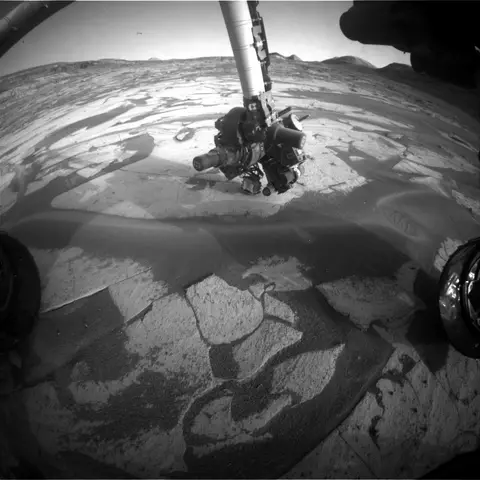 Curiosity · Sol 5,038Front Hazard Avoidance Camera (Hazcam)NASA/JPL-Caltech
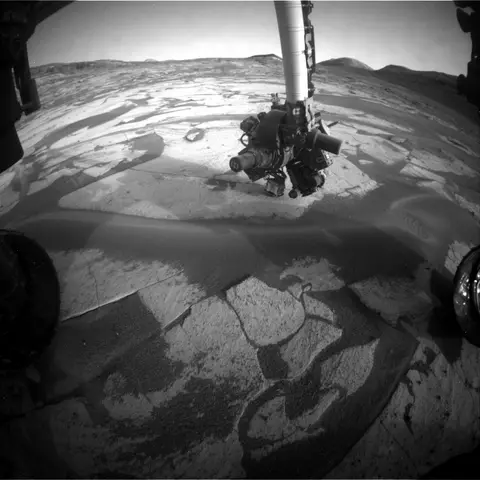 Curiosity · Sol 5,038Front Hazard Avoidance Camera (Hazcam)NASA/JPL-Caltech
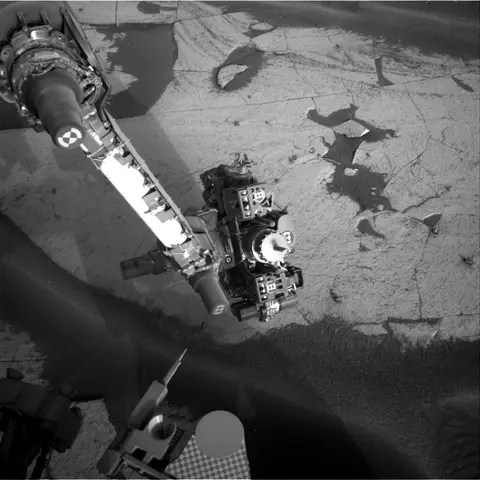 Curiosity · Sol 5,038Navigation Camera (Navcam)NASA/JPL-Caltech
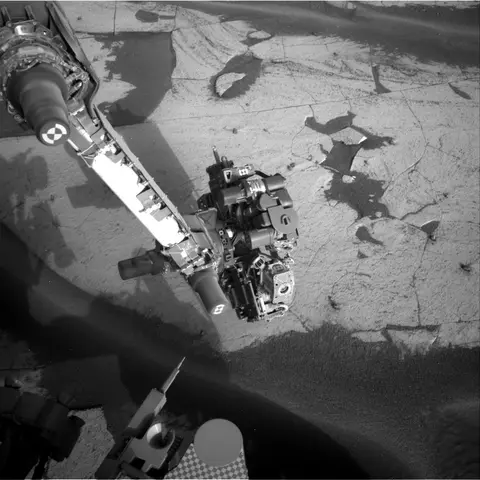 Curiosity · Sol 5,038Navigation Camera (Navcam)NASA/JPL-Caltech
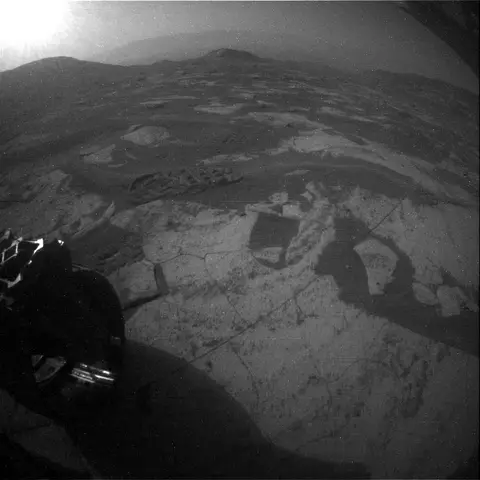 Curiosity · Sol 5,036Rear Hazard Avoidance Camera (Hazcam)NASA/JPL-Caltech
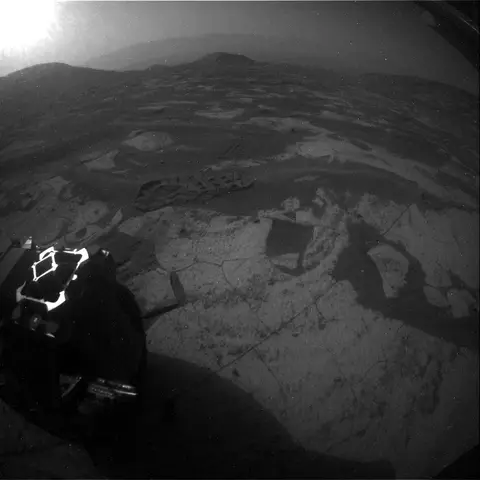 Curiosity · Sol 5,036Rear Hazard Avoidance Camera (Hazcam)NASA/JPL-Caltech
Questions
Is Curiosity rover still working?
Yes. It sent new images from its sol 5,033 (Oct 3, 2026) and has drilled a new rock sample, “Basque Lakes”, on Mount Sharp.
Where is Curiosity rover now?
In “Valle Grande”, a valley on the slopes of Mount Sharp inside Gale Crater, about 1 km higher than where it landed.
How long has Curiosity been on Mars?
5,039 sols, more than 14 Earth years, since it landed on Aug 6, 2012. It reached sol 5,000 on Aug 30, 2026.
How far has Curiosity driven?
more than 38 km (23.6 mi) by sol 5,021, in September 2026, by NASA’s map data.
What time is it at Gale Crater?
09:02, morning, by the mission’s own clock. A day on Mars lasts 24 hours, 39 minutes and 35 seconds.
How is Curiosity powered?
By a nuclear power source that turns heat from decaying plutonium-238 into electricity. Perseverance carries an identical one.
Sources
- NASA Science — Curiosity (MSL)Primary · checked Oct 4, 2026
- NASA NSSDCA — Mars Science Laboratory (2011-070A)Primary · checked Oct 4, 2026
- NASA GISS — Mars24: landers and roversPrimary · checked Oct 4, 2026
- NASA Science (Curiosity blog) — Curiosity Blog, Sols 5016–5021: Fantastic Minerals and How To Detect ThemPrimary · checked Oct 4, 2026
- NASA Mars rover map data — Curiosity current position (waypoints file)Primary · checked Oct 4, 2026
- NASA Science — Curiosity Reaches 1-Kilometer Elevation GainPrimary · checked Oct 4, 2026
- NASA Science (Photojournal) — Curiosity Postcard Celebrates Rover’s 5,000th Day on MarsPrimary · checked Oct 4, 2026
- NASA Science (Curiosity blog) — Curiosity Blog, Sols 4995–5001: 5,000 (Martian) Days on MarsPrimary · checked Oct 4, 2026
- NASA JPL — NASA Rover Finds Conditions Once Suited for Ancient Life on MarsPrimary · checked Oct 4, 2026
- NASA JPL — Simulated View of Gale Crater Lake on Mars (PIA19080)Primary · checked Oct 4, 2026
- NASA JPL — NASA Finds Ancient Organic Material, Mysterious Methane on MarsPrimary · checked Oct 4, 2026
- NASA Science — NASA’s Curiosity Rover Detects Largest Organic Molecules Found on MarsPrimary · checked Oct 4, 2026
- NASA — NASA’s Curiosity Rover Sees Martian Spiderwebs Up ClosePrimary · checked Oct 4, 2026
- NASA — NASA’s Curiosity Mars Rover Discovers Field of Honeycomb TexturesPrimary · checked Oct 4, 2026
- NASA Science — Curiosity’s 42 Drill HolesPrimary · checked Oct 4, 2026
- NASA JPL — Mars 2020 launch press kit: PowerPrimary · checked Oct 4, 2026
- Ars Technica — The first self-driving vehicle on Mars has proven to be a smashing successSecondary · checked Oct 4, 2026
- NASA — Curiosity raw imagesPrimary · checked Oct 4, 2026
- NASA Science — Curiosity's First Sample DrillingPrimary · checked Oct 4, 2026
- NASA Science (Curiosity blog) — Curiosity Blog, Sols 5022–5028: Cashing in at Cache CreekPrimary · checked Oct 5, 2026
- NASA Science (Curiosity blog) — Curiosity Blog, Sols 5029–5035: Back in the LabPrimary · checked Oct 6, 2026