Japan (JAXA) · Sample returnGetting ready to launch
MMX: Martian Moons eXploration
MMX is Japan’s mission to bring back samples of Phobos, the larger of Mars’s two moons. JAXA is scheduled to launch it on Oct 20, 2026 (Japan time) from Tanegashima. The spacecraft should reach Mars in 2027 and bring the samples to Earth in Japan’s fiscal 2031 (April 2031 to March 2032).
Updated Sources (15)
When does MMX launch?
On Oct 20, 2026, at 04:41 Japan time, which is 19:41 UTC on Oct 19. An H3 rocket in its H3-24L version, with two main engines and four solid boosters, is to lift off from the Yoshinobu Launch Complex at JAXA’s Tanegashima Space Center. If the launch slips, JAXA has reserved Oct 21 to Nov 7, with a new launch time for each day.[1][2][3] The spacecraft separates from the rocket about 1 hour 11 minutes after liftoff, already on its way to Mars.[3]
It will be the H3’s third flight since a failure on Dec 22, 2025 that lost a navigation satellite. Flight 6, a test of a new version on Jun 12, 2026, and the ninth flight, on Aug 11, 2026, both went as planned.[8][13][9]
What will MMX do?
JAXA plans a round trip of about five years: about a year to reach Mars, about three years near it, then the flight home.[2][4]
- The spacecraft arrives at Tanegashima by ship from Mitsubishi Electric’s plant in Kamakura, which it left on Mar 28.[14]
- Launch on H3 flight 10.
- Arrives at Mars and enters orbit.
- Studies Phobos from a close orbit and drops the IDEFIX rover, which DLR says should land in 2029. MMX itself then lands on Phobos, twice if possible, to collect samples; JAXA hasn’t given dates. Flybys of Deimos come near the end.
- Leaves Mars for home.
- The sample capsule lands in Australia.
Why go to Phobos?
To find out where Mars’s moons came from. One idea is that Phobos and Deimos are asteroids that Mars captured. The other is that they formed from debris thrown up when something large hit Mars. JAXA says the returned sample “will settle the debate”.[2][4]
Phobos may also hold dust blasted off Mars by impacts, so the capsule could bring back a little of Mars itself.[6] JAXA calls MMX the world’s first mission to return material from the Mars system.[4]
How will MMX collect samples?
MMX carries two samplers: a corer on a robotic arm, and a pneumatic sampler on one of its landing legs, provided by NASA and built by Honeybee Robotics. JAXA aims to collect more than 10 grams, from at least 2 cm below the surface.[2][5][12][15]
Before MMX lands, it drops IDEFIX, a 25 kg rover from France’s space agency CNES and Germany’s DLR, from about 40 m above Phobos. The rover is planned to work for about 100 days.[6]
Who is building MMX?
- 01JAXA leads the mission. Mitsubishi Electric built the spacecraft: three modules for the trip out, the work at Phobos and the trip home, 4,480 kg at launch.[2][4]
- 02NASA provides MEGANE, a gamma-ray and neutron spectrometer that measures what Phobos is made of, plus the pneumatic sampler and ground-station support.[7][12]
- 03CNES and DLR built the IDEFIX rover together; CNES also provides MIRS, a near-infrared spectrometer.[6][7]
- 04ESA provides the spacecraft’s deep-space radio equipment and ground-station support.[7]
Why didn’t MMX launch in 2024?
MMX was first planned to launch in Japan’s fiscal 2024. In December 2023 Japan’s government moved the launch to fiscal 2026 and the return to fiscal 2031.[10] JAXA said it needed to evaluate the H3 rocket’s second test flight, after the first failed in March 2023, and wanted more time to test MMX on the ground.[11] Because Mars launch windows come about every 26 months, a delay moves a mission in two-year steps.
Latest MMX news
All Mars news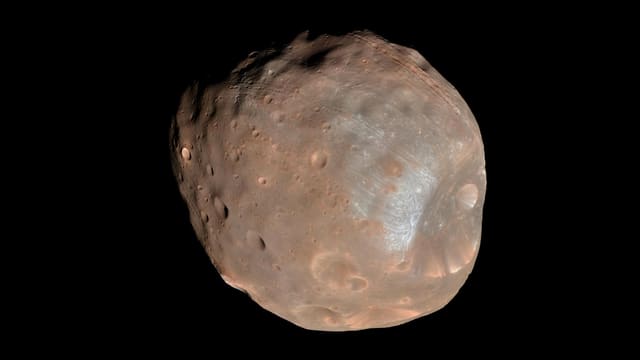
Questions
When does MMX launch?
On Oct 20, 2026, at 04:41 Japan time (Oct 19, 19:41 UTC), on an H3 rocket from Tanegashima. JAXA has reserved Oct 21 to Nov 7 as backup days.
What does MMX stand for?
Martian Moons eXploration. It’s JAXA’s mission to Mars’s two moons, Phobos and Deimos.
When will MMX bring samples back?
In Japan’s fiscal 2031, which runs from April 2031 to March 2032. The capsule is planned to land in Australia.
How much will MMX bring back?
JAXA aims to collect more than 10 grams of Phobos, from at least 2 cm below the surface, with a corer on a robotic arm and a pneumatic sampler on a landing leg.
Will MMX land on Mars?
No. It lands on Phobos, Mars’s larger moon, after studying it from orbit. A small French–German rover, IDEFIX, is planned to land on Phobos first.
Sources
- JAXA — Launch of the MMX spacecraft onboard the H3 Launch Vehicle No. 10Primary · checked Oct 2, 2026
- JAXA — MMX press kit (revised Sep 16, 2026)Primary · checked Oct 2, 2026
- JAXA — H3 Launch Vehicle No. 10 launch plan (Japanese)Primary · checked Oct 2, 2026
- JAXA — MMX: Martian Moons eXplorationPrimary · checked Oct 2, 2026
- JAXA — MMX science and instrumentsPrimary · checked Oct 2, 2026
- DLR — Off to the moons of Mars: MMX mission and Idefix rover ready for launchPrimary · checked Oct 2, 2026
- JAXA — MMX team and partnersPrimary · checked Oct 2, 2026
- JAXA — Results of the H3 Launch Vehicle Flight No. 8Primary · checked Oct 2, 2026
- JAXA — Launch result of the H3 Launch Vehicle No. 9Primary · checked Oct 2, 2026
- Cabinet Office, Government of Japan — Basic Plan on Space Policy, revised schedule (Japanese)Primary · checked Oct 2, 2026
- SpaceNews — Japanese Mars mission launch delayed to 2026Secondary · checked Oct 2, 2026
- NASA Science — MMXPrimary · checked Oct 2, 2026
- JAXA — Launch Result of H3 Launch Vehicle flight No.6, 30 configuration Test VehiclePrimary · checked Oct 4, 2026
- JAXA ISAS — The Martian Moons eXploration (MMX) spacecraft has successfully been delivered to the JAXA Tanegashima Space CenterPrimary · checked Oct 4, 2026
- JAXA MMX — The development of the P-SMP flight model for MMX is now completePrimary · checked Oct 4, 2026